Reading Time: 3 minutes
Content
What COVID‑19 Revealed About Research, Transparency, and Human Responsibility
When the world shut down in 2020, humanity witnessed more than a pandemic. We witnessed the consequences of a global system unprepared for its own scientific complexity. COVID‑19 was not just a health crisis; it was a mirror held up to our institutions, our research practices, and our collective ability to respond to danger. More than 7 million confirmed deaths have been recorded worldwide, and the real toll is likely higher due to inconsistent reporting and limited testing. Even today, people continue to die from a virus that reshaped our lives, our economies, and our understanding of vulnerability.
Yet despite this enormous loss, the world has not fully absorbed the lessons that COVID‑19 tried to teach.
A Crisis That Exposed the Cracks
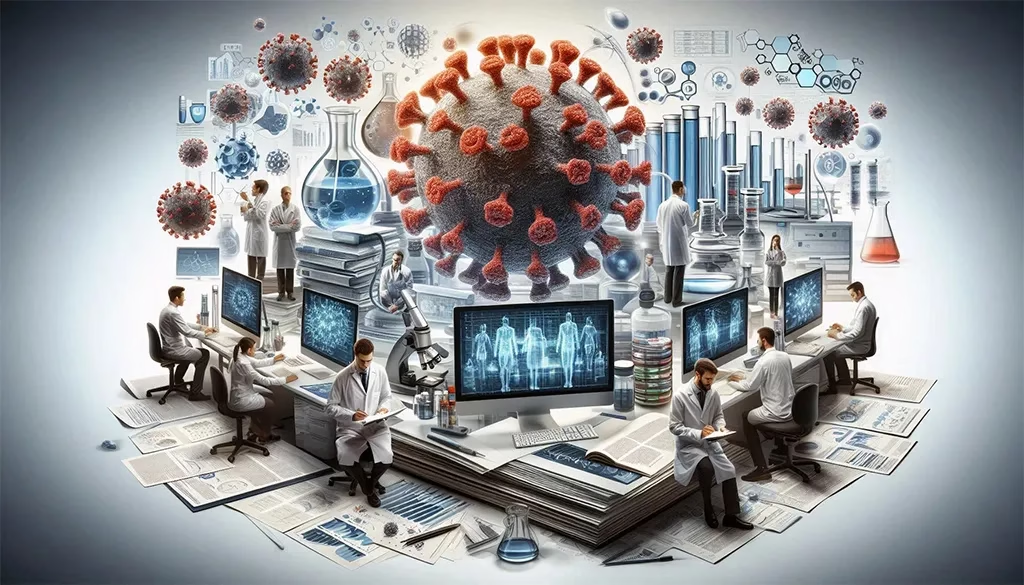
COVID‑19 revealed something uncomfortable: our global research ecosystem is fragmented, opaque, and unevenly regulated. Countries reported data differently. Some counted only hospital deaths; others included suspected cases. Laboratories, governments, and health systems often worked in isolation, even as the virus crossed borders effortlessly.
The outcome was confusion, mistrust, and slow responses—conditions that let the virus spread faster than we could grasp it. This wasn’t just a shortfall in science; it was a breakdown in coordination and a lack of necessary government regulations.
When Research Lacks Transparency
Scientific research is powerful, but without transparency, it becomes fragile. COVID‑19 showed how quickly misinformation can fill the gaps when data is incomplete or inconsistent. It also highlighted the need for stronger oversight of high‑risk research, especially work involving pathogens.
The world must confront a difficult truth: research that is not transparent, integrated, and responsibly regulated can create risks as large as the problems it tries to solve.
Why We Haven’t Learned Enough
You would think a global disaster of this scale would lead to unified reforms. But the reality is more complicated:
- Nations moved on at different speeds.
- Public fatigue overshadowed long‑term planning.
- Political polarization weakened trust in science.
- Economic recovery took priority over structural change.
The result is a world that remembers the fear but forgets the lesson.
The Responsibility We Still Carry
Natural Memo exists to explore the deeper layers of human experience—mental balance, resilience, and the hidden forces that shape our lives. COVID‑19 is one of those forces. It taught us that health is not just physical, and that the consequences of scientific decisions ripple through society in ways we rarely anticipate.
The pandemic reminded us that:
- Transparency is not optional.
- Collaboration is not a luxury.
- Regulation is not bureaucracy—it is protection.
- Human lives depend on systems we often take for granted.
If we ignore these truths, we risk repeating the same mistakes.
A Call for Integrated Wisdom
The world doesn’t need fear; needs clarity.
It needs shared responsibility.
It needs research that honors human life as much as scientific progress.
COVID‑19 was a tragedy, but it can also be a teacher—if we choose to listen.
Natural Memo stands for mental balance, thoughtful reflection, and the courage to confront uncomfortable truths. This moment in history asks us to do exactly that: to learn, to adapt, and to build a future where science and humanity move together, not apart.
Key Takeaways
- COVID‑19 revealed that our global research ecosystem is fragmented and poorly regulated, leading to confusion and mistrust.
- The pandemic highlighted the dangers of non-transparent research, emphasizing the need for stronger oversight, especially with high-risk studies.
- Despite the scale of the crisis, countries moved at different speeds, and public fatigue overshadowed long-term planning.
- The responsibility remains to ensure transparency, collaboration, and regulation to prevent repeating past mistakes.
- COVID‑19 serves as a reminder that health extends beyond the physical, requiring systems that prioritize human life alongside scientific progress.
Related Articles
Robert F. Kennedy Jr. – Wikipedia