
Reading Time: 4 minutes
Content
A bit of sarcastic flair from the author: Cuban negotiations with the US—a carefully choreographed diplomatic tango where the rich aroma of coffee mingles with the sharp scent of political maneuvering, and everyone prays that the salsa remains a condiment and not a metaphor for the heated exchanges. It’s a performance where every step is calculated, every smile rehearsed, and the real question is whether the music will end before someone accidentally steps on a national interest.
Cuba must negotiate a solution with the US before it is too late.
But there are several factors that must be considered:
- The humanitarian collapse
The social and economic crisis has reached a point where the Cuban people cannot endure further deterioration. Any negotiation must prioritize food security, medical access, and the protection of civil liberties. Additionally, Cuban negotiations with the US are often influenced by these urgent humanitarian concerns. - The geopolitical shift
The regional landscape is changing rapidly. Cuba risks isolation if it fails to adapt to new hemispheric dynamics, especially as other nations reassess their alliances and internal policies. Therefore, Cuban negotiations with the US must also take into account these evolving geopolitical trends. - The diaspora’s role
Millions of Cubans abroad — especially in the United States — are now central actors. Their economic power, political influence, and moral authority must be acknowledged in any long‑term solution. In the context of all these factors, direct negotiations between Cuba and the US also deeply affect the diaspora’s involvement. - The need for credible reforms
Negotiations cannot succeed without concrete steps toward transparency, economic openness, and respect for fundamental rights. Symbolic gestures are no longer enough. In fact, for the United States and Cuba, successful negotiations depend on credible change. - The urgency of national reconciliation
Cuba needs a path that avoids further suffering and prevents a chaotic collapse. Dialogue must include all sectors: civil society, the diaspora, and those inside the island who want peaceful change. Above all, dialogue will shape the outcome of these ongoing negotiations between the US and Cuba.
Díaz‑Canel, a political figure who does not represent the Cuban people.
It is important to understand that Díaz‑Canel does not represent the Cuban people, but rather the roughly 500,000 members of the Communist Party who sustain the current system. Senator Marco Rubio, on the other hand, speaks as an elected representative of the United States and its citizens. If we want a solid and lasting solution, several principles must guide the path forward. Also, the success of any future Cuban negotiations with the US will depend on addressing these leadership challenges.
- Legitimacy matters
Any negotiation must acknowledge the difference between a government that rules through a single‑party structure and a government elected by its people. This imbalance shapes expectations, responsibilities, and the credibility of any agreement. Cuban negotiations together with the US are further complicated by differing systems of legitimacy. - The Cuban people must be centered
A sustainable solution cannot be built around party elites. It must reflect the needs, rights, and aspirations of the Cuban population — both on the island and in the diaspora. - The United States will negotiate based on democratic accountability
U.S. officials answer to voters, institutions, and public scrutiny. That reality influences the type of agreements they can support and the transparency required. Similarly, Cuban negotiations that occur directly with the US may face public pressure for democratic outcomes.
Reforms & Dignity
- Reforms must be real, not symbolic
Economic openings, human‑rights guarantees, and political space for civil society are essential. Without tangible commitments, no negotiation will hold. In fact, Cuban negotiations with the US will likely stall unless both parties can prove the legitimacy of such reforms. - The goal is stability with dignity
The objective is not punishment or humiliation, but a transition that prevents further suffering and opens a path toward national reconciliation.
But could be the best outcome:
- The dissolution of assemblies: The official suspension of the powers and responsibilities of legislative bodies at every level of government. Such steps may facilitate a new stage in negotiations on the future relationship between Cuba and the US.
- New Elections: Following the dissolution of the assembly by President Díaz-Canel, authorities have announced that new elections will be organized and held in the near future.
- Candidates are freely nominated and not pre‑selected by the PCC. In the scenario of open elections, Cuban and US negotiators may find common ground through genuinely competitive processes.
- Any Cuban with a valid Cuban passport can run in the new elections.
- People who are not part of the communist party can form alliances to choose the president. If alliances cross these dividing lines, future negotiations—Cuban or US-led—will likely be transformed.
- If the communists win most of the seats, they’ll reelect Díaz-Canel, but only for another two years.
The future of Diaz-Canel
- If the communists lose. Diaz-Canel retires to lead the biotechnology initiative corporation and receives immunity.
One way or another, communists declare they will keep fighting for social justice, aiming to establish a social democracy, but only through fair elections. This pursuit of democracy could become a cornerstone in upcoming US and Cuban negotiations.
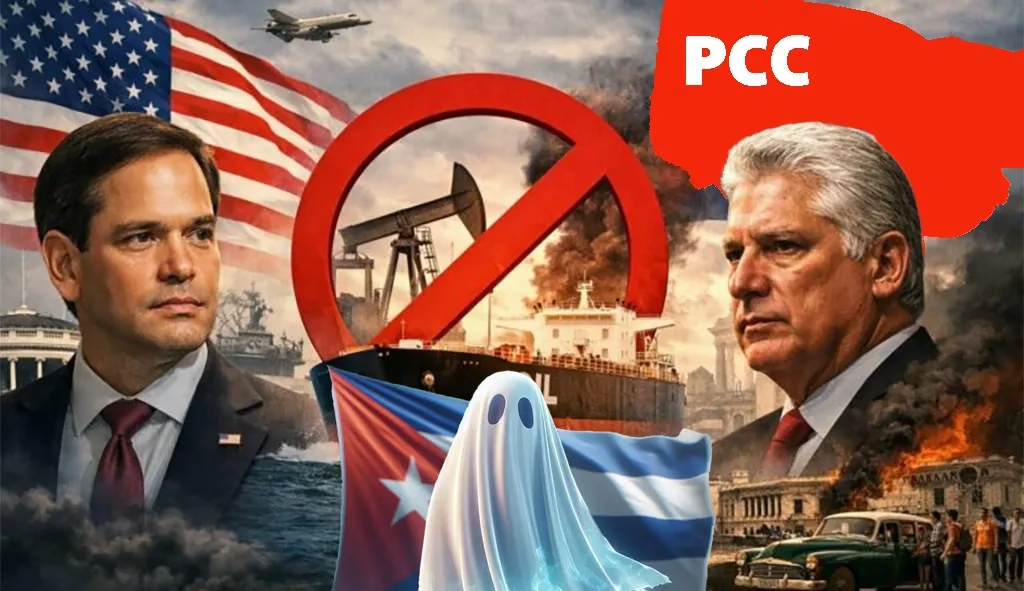
The story could still have a happy ending, but we’re missing that one magical politician who can truly represent the Cuban people. On one side, there’s Díaz-Canel waving the Communist flag; on the other, Marco Rubio sipping American coffee. But who will rise as *the* one? Will it be a charismatic leader of flesh and blood, or just a mysterious ghost drifting through political speeches? For now, it’s only the ghost showing up… and even it seems to be running late. By the way, the outcome of US negotiations with Cuba depends on who emerges as the real voice of the people.
Key Takeaways
- Cuban negotiations with the US require addressing critical factors like the humanitarian crisis and geopolitical shifts.
- The diaspora’s influence and need for credible reforms are essential for successful negotiations.
- Díaz-Canel does not represent the Cuban people; a legitimate government is needed for effective discussions.
- Negotiations must center on the Cuban population’s rights and aspirations, not just party elites.
- The goal is stability with dignity, focusing on real reforms and a transition toward national reconciliation.
Traveling Related Ad
Retro Mini Campus Life Student Party Digital Camera – GemsLeaf Travel


